Use of the Right Form of the Verbs For Class VII
Table of Contents
Right Form of the verbs এমন একটি গ্রামার যেই গ্রামারটি অন্যান্য সকল গ্রামারকে একসাথে করে নিয়ে আসে। যেমন, আপনি যদি Sentence, Voice, Transformation, Narration, Conjugation of verbs সহ অন্যান্য গ্রামার ভালোমত না শিখেন তাহলে আপনি এই গ্রামারটি ভারোমত আতস্থ করতে পারবেন না।
আরো পড়ুন >> Completing Sentence Suggestion For SSC (ক্লিক করুন এখানে)
উপরের লিংকটিতে ক্লিক করলে আপনি Completing Sentence সম্পর্কিত সকল নিয়ম এবং উদাহরণ দেখতে পারবেন। যেটা এসএসসি পরীক্ষার্থীদের জন্য প্রয়োজনীয়।
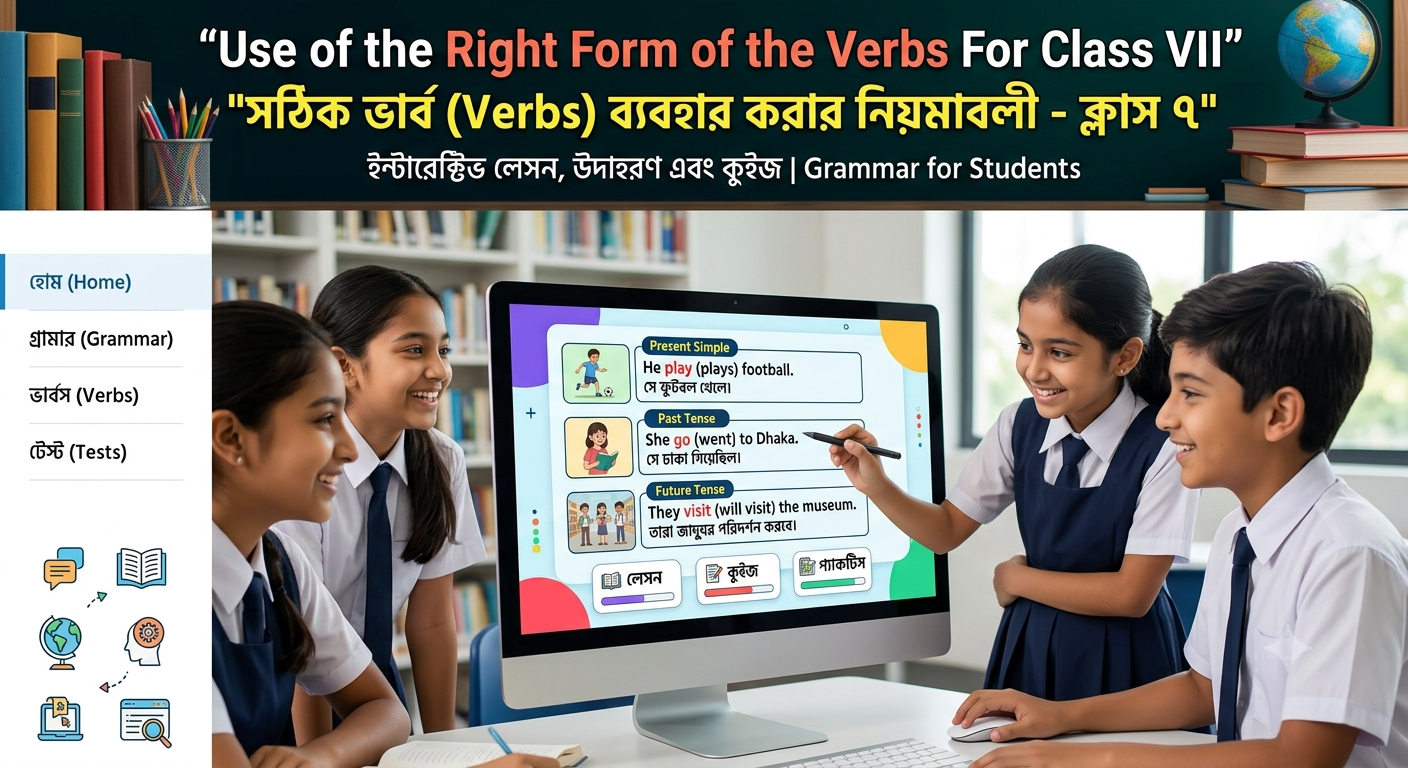
সকল গ্রামারের সামষ্টিক রূপ হলো এই গ্রামারটি। Right Form of the Verbs শিখতে হলে প্রথমে টেন্স (Tense), সাবজেক্ট-ভার্ব এগ্রিমেন্ট (Subject-Verb Agreement) এবং কিছু মৌলিক নিয়ম খুব ভালোভাবে আয়ত্ত করতে হবে।
মৌলিক ধাপসমূহ
টেন্স আয়ত্ত করুন: বারো প্রকার টেন্সের গঠন ও তাদের ব্যবহার ভালো করে জানুন। কারণ বেশিরভাগ সঠিক ভার্বের রূপ টেন্সের ওপর নির্ভর করে।
সাবজেক্ট ও ভার্বের সম্পর্ক বুঝুন: সাবজেক্ট একবচন (singular) হলে ভার্বও একবচন হবে, আর সাবজেক্ট বহুবচন (plural) হলে ভার্বও বহুবচন হবে। যেমন—সাবজেক্ট থার্ড পারসন সিঙ্গुलर নাম্বার হলে প্রেজেন্ট ইনডিফিনিট টেন্সে ভার্বের সাথে s বা es যুক্ত হয়।
নির্দিষ্ট কিছু শব্দ চিনে রাখুন: বাক্যে always, daily, regularly, yesterday, tomorrow, just, just now, already ইত্যাদি শব্দ থাকলে কোন টেন্স হবে তা মুখস্থ না করে বুঝে পড়ুন।
Preposition ও Modal Auxiliaries এর নিয়ম জানুন: to, by, for, of ইত্যাদির পরে ভার্বের সাথে ing বসে (Gerund)। আবার can, could, may, might, should, must ইত্যাদির পরে সবসময় ভার্বের বেস ফর্ম (মূল রূপ) বসে।
নিয়মিত এক্সারসাইজ বা চর্চা করুন: প্রতিদিন অন্তত একটি করে প্যাসেজ বা বোর্ড কোশ্চেন সমাধান করুন। ভুলগুলো কোথায় হচ্ছে তা মিলিয়ে দেখুন।
Right Form of the Verbs PDF
এই পিডিটএফ টি নেওয়ার জন্য = ক্লিক করুন এখানে (লিংকটিতে ক্লিক করলেই আপনি পিডিএফ ফাইল পেয়ে যাবেন)
উপরের লিংক থেকে আপনি সরাসরি ডাউনলোড করে নিয়ে পড়তে পারবেন। আশা করবো নিয়মগুলো শিখতে পারলে আপনি সহজেই আয়ত্ব করতে পারবেন এই গ্রামার অংশটি।
Right form of verb-এর ৪০টি নিয়ম
1. SentenceযদিPresent indefinite tense হয়এবং Subject যদি Third Person singular number হয়, তবে verb-এরসঙ্গে s/es যুক্তহয়। যেমন:
The baby (cry).
Ans.: The baby cries.
2. Before দ্বারাদুটি Past tense যুক্তথাকলে before-এরআগেরঅংশে Past perfect tense এবংপরেরঅংশ Past indefinite tense হয়। যেমন:
We (reach) our school before the bell rang.
Ans: We had reached our school before the bell rang.
The patient had died before the doctor (come).
Ans: The patient had died before the doctor came.
3. Afterদ্বারাদুটিPast tense যুক্তথাকলেএরআগেরঅংশ Past indefinite tense এবংপরেরঅংশ Past perfect tense হয়। যেমন:
They arrived the station after the train (leave).
Ans.: They arrived the station after the train had left.
The patient (die) after the doctor had come.
Ans.: The patient died after the doctor had come.
4. Right Form of Verbs-এ No sooner had ... than নিয়মের মূল গঠন ও শেখার সহজ উপায় হলো প্রথম অংশে had-এর পর verb-এর পাস্ট পার্টিসিপল (V3) এবং than-এর পরের অংশে পাস্ট ইনডিফিনিট টেন্স বা verb-এর পাস্ট ফর্ম (V2) ব্যবহার করা। যেমন,
 No sooner had I reached home than it started raining.
 আমি বাসায় পৌঁছানোর সঙ্গে সঙ্গেই বৃষ্টি শুরু হলো। No sooner had she finished her exam than she left the room. পরীক্ষা শেষ করেই সে রুম থেকে বেরিয়ে গেল। No sooner had they arrived than the meeting began. তারা পৌঁছানোর সঙ্গে সঙ্গেই মিটিং শুরু হলো।
6. Hardly had ………. when—প্রথমঅংশ Past perfect tense অনুযায়ীহয়, অর্থাৎ verb-এর Past participle form হবে।দ্বিতীয়অংশ Past indefinite tense অনুযায়ীহয়, অর্থাৎ verb-এর Past form হয়। যেমন:
No sooner had the bell (ring) than the teacher (enter) the classroom.
Ans.: No sooner had the bell rung than the teacher entered the classroom.
Scarcely had he (arrive) at the bus stand when the bus (leave).
Ans.: Scarcely had he arrived at the bus stand when the bus left.
7. সাধারণত since দ্বারাদুটি clause যুক্তথাকলেএবং since-এরআগেরঅংশ Present indefinite/Present perfect tense হলেপরেরঅংশ Past indefinite tense হয়। যেমন:
It is many years since he (give) up smoking.
Ans.: It is many years since he gave up smoking.
Five years have passed since he (leave) the house.
Ans.: Five years have passed since he left the house.
8. আবার since দ্বারা clause যুক্তথাকলেএবং since-এরআগে clause বাবাক্যেরঅংশ Past indefinite tense হলেপরেরঅংশ verb -এর Past perfect tense হয়। যেমন:
Many years passed since I (meet) him last.
Ans: Many years passed since I had met him last.
It was many years since I (visit) there.
Ans: It was many years since I had visited there.
9. Passive voice-এসর্বদা verb-এর past participle form হয়।
যেমন: This work was (do) by him.
Ans.: This work was done by him.
The problem has been (solve) by him.
Ans.: The problem has been solved by him.
The school was (close) for sine die.
Ans.: The school was closed for sine die.
10. Simple sentence-এদুটিverbথাকলেদ্বিতীয় verb-এরসঙ্গে ing যোগহয়অথবাদ্বিতীয় verbটিরআগে to বসে।
যেমন: He saw the boy (play) in the field.
Ans.: He saw the boy playing in the field.
I heard him (speak).
11. Simple sentence-এদুটিverbথাকলেদ্বিতীয় verb-এরসঙ্গে ing যোগহয়অথবাদ্বিতীয় verbটিরআগে to বসে।
যেমন: He saw the boy (play) in the field.
Ans.: He saw the boy playing in the field.
I heard him (speak).
12. Note :দ্বিতীয়verbটিযদিউদ্দেশ্যবোঝাতেব্যবহূতহয়তবেদ্বিতীয় verb-এরআগে to বসে।
যেমন: I went to the library (read) newspaper.
Ans.: I went to the library to read newspaper.
He repaired the boat (sell) it.
Ans.: He repaired the boat to sell it.
13. Modal auxiliary verbযেমন: can, could, may, might, should, would, ought to, used to, must ইত্যাদিথাকলেমূল verb-এর present form হয়।
যেমন: He can (do) it easily. Ans.: He can do it easily.
Everybody should (respect) his parents.
Ans.: Everybody should respect his parents.
It may (rain) today. Ans.: It may rain today.
14. সাধারণতsentence যদিভবিষ্যৎনির্দেশকশব্দবা phrase যেমন: tomorrow, the day after tomorrow, in future, next ইত্যাদিথাকলে future indefinite tense হবেএবং verb-এর present form বসে।
যেমন: I (go) to Dhaka tomorrow.
Ans.: I shall go to Dhaka tomorrow.
He (join) there the next day.
Ans.: He will join there the next day.
15. Sentence-এরsubject singular numberহলে verb singular হয়এবং subject plural হলে verb plural number হয়।
যেমন: The taste of the mangoes (to be) sour.
Ans.: The taste of the mangoes is sour.
The flowers of the garden (to be) beautiful.
Ans.: The flowers of the garden are beautiful.
These papers (to be) printed.
Ans.: These papers are printed.
16. মূলverb-এরআগে to be বা having থাকলে verb-এর past participle form হয়।
যেমন: A community centre is going to be (establish).
Ans.: A community centre is going to be established.
I do not mind (have) a cup of coffee.
Ans.: I do not mind having a cup of coffee.
He went home (have) his salary.
Ans.: He went home having his salary.
,
17. সাধারণতIt is time, it is high time, wish ইত্যাদিরপরে subject ও bracket-এমূল verb থাকলে verb-এর past form হয়।
যেমন: It is time you (finish) a course on English language.
Ans.: It is time you finished a course on English language.
I wish I (sing). Ans.: I wish I sang.
আবার, It is time, it is high time-এরপরযদি bracket-এমূল verb থাকে, তবেওই verb-এরআগে to বসবেএবংওই verb অপরিবর্তিতথাকবে।
যেমন: It is time (play). Ans.: It is time to play.
It is high time (stand) by the flood-affected people.
Ans.: It is high time to stand by the flood-affected people.
18. As if, as though, wishইত্যাদিথাকলেsubject-এরপরে be verb-এরপরিবর্তে were বসে।
যেমন: He behaves as if he (be) a leader.
Ans.: He behaves as if he were a leader.
I wish I (be) a millionaire.
Ans.: I wish I were a millionaire.
19. As if, as thoughদ্বারাদুটিclause যুক্তথাকলেপ্রথম clauseটি Present tense হলেপরবর্তী clauseটি Past indefinite হয়।প্রথম clauseটি Past tense হলেপরের clauseটি Past perfect tense হয়।
যেমন: He behaves as if he (buy) the car.
Ans.: He behaves as if he bought the car.
He spoke as though he (do) a great task.
Ans.: He spoke as though he had done a great task.
20. Whileযুক্তsentence-এ while-এরপরে verb থাকলে verb-এরসঙ্গে ing যোগহয়।আবার while-এরপরে subject থাকলে Past continuous tense হয়।
যেমন: While (take) dinner, he received the phone. Ans.: While taking dinner, he received the phone.
While I (play) in the field, I saw him coming.
Ans.: While I was playing in the field, I saw him coming.
21. Lestদ্বারাদুটিclause যুক্তথাকলে lest-এরপরবর্তী subject-এরসঙ্গে auxiliary verb ‘should’/‘might’ বসে।
যেমন: Read attentively lest you (fail) in the examination.
Ans.: Read attentively lest you should fail in the examination.
Walk fast lest you (be) late in your class.
Ans.: Walk fast lest you might be late in your class.
22. Would thatদ্বারাsentence শুরুহলে subject-এরপরে could বসেএবংমূল verb-এর Present form হয়।
যেমন: Would that I (be) a bird! Ans.: Would that I could be a bird!
Would that I (visit) Cox’s Bazar .
Ans.: Would that I could visit Cox’s Bazar.
23. সাধারণতeach, one of, every, either, neither ইত্যাদিদ্বারাকোনো subject গঠিতহলেসেটি third person singular number হয়।তাইএদেরপরের verbটিও singular number হয়।
যেমন: Each boy (come) here. Ans.: Each boy comes here.
Everybody (wish) to be happy. Ans.: Everybody wishes to be happy.
24. Adjective-এরআগেtheবসলে subject টি plural হয়এবংতদনুযায়ী verb বসে।
যেমন: The virtuous (to be) blessed.
Ans.: The virtuous are blessed.
The poor (live) from hand to mouth.
Ans.: The poor live from hand to mouth.
25. Titles, names, phrase of measurementদেখতেplural হলেও singular verb হয়।
যেমন: Thirty miles (to be) a long way.
Ans.: Thirty miles is a long way.
Star Wars (to be) an excellent movie.
Ans.: Star Wars is an excellent movie.
Eight hours (to be) a long time to work.
Ans.: Eight hours is a long time to work.
26. কোনোsentence ‘It’ দ্বারাশুরুহলেপরবর্তী verb singular হয়।
যেমন: It (to be) difficult to do.
Ans.: It is difficult to do.
It (to be) you who have done this.
Ans.: It is you who have done this.
27. কোনোsentence যদি introductory there দ্বারাশুরুহয়এবংতারপর singular number থাকে, there-এর singular verb হয়।আরযদি there-এরপরে plural number থাকেতবে plural verb হয়।
যেমন: There (to be) a big river beside our village.
Ans.: There was a big river beside our village.
There (to be) a lot of work left for us.
Ans.: There were a lot of work left for us.
28. Let, had better, had rather, would better, would ratherইত্যাদিথাকলেform বসে।
যেমন: I would rather die than (beg) .
Ans.: I would rather die than beg.
Would you let me (go) there?
Ans.: Would you let me go there?
29. Ifযুক্তclause-এরপ্রথমঅংশ Present indefinite tense হলেপরেরঅংশ Future indefinite হয়, অর্থাৎ structureটিহয় ‘If + Present + Future’
যেমন: If you work hard, you (prosper) in life.
Ans.: If you work hard, you will prosper in life.
30. If-যুক্তclause-এরপ্রথমঅংশIndefinite tense হলেপরেরঅংশে subject-এরপরে would/could/might বসেএবং verb-এর Present form হয়।অর্থাৎ, structureটিহয় ‘If + Past indefinite’ (Subject + would/could/might + verb-এর Present form)।
যেমন: If he agreed, I (give) the money.
Ans: If he agreed, I would give the money.
If you studied, you (get) a good result.
Ans: If you studied, you would get a good result.
If they tried, they (succeed).
Ans.: If they tried, they would succeed.
31. If-যুক্তclause-এরপ্রথমঅংশPast perfect tense হলেপরেরঅংশে subject-এরপরে would have/could have/might have বসেএবং verb-এর Past participle form হয়।
যেমন: If you had finished it sincerely, you (get) a profit. Ans.: If you had finished it sincerely, you would have got a profit.
If I had possessed vast wealth, I (help) the poor people.
Ans.: If I had possessed vast wealth, I would have helped the poor people.
32. To ব্যাতিত Preposition-এরপরের verb-এরসঙ্গে ing যুক্তহয়।
যেমন: He is now engaged in (read).
Ans.: He is now engaged in reading.
One can gather knowledge by (travel).
Ans.: One can gather knowledge by traveling.
33. Can not help, could not help, look forward to, with a view to, get used to, mindইত্যাদিরপরেverb-এরসঙ্গে ing যুক্তহয়।
যেমন: He came to Dhaka with a view to (find) a job.
Ans.: He came to Dhaka with a view to finding a job.
I cannot help (laugh).
Ans.: I cannot help laughing.
34. কোনোsentence-এরশুরুতে subject-এরস্থানে verb থাকলে verb-এরসঙ্গে ing যোগহয়।
যেমন: (To swim) is a good exercise.
Ans.: Swimming is a good exercise.
(To speak) is an art.
Ans.: Speaking is an art.
35. If-যুক্তclause-এরপ্রথমটিতেsubject-এরপর were থাকলেদ্বিতীয়অংশে subject-এরপরে would/could/ might বসেএবং verb-এর Present from বসে।আবার, would have/could have/would have-ওবসতেপারে।সেক্ষেত্রে verb-এর Past participle form বসে।
যেমন: If I were an artist, I (draw) a nice picture.
Ans: If I were a artist, I would draw a nice picture.
If I were a billionaire, I (establish) a hospital for the poor.
Ans.: If I were a billionaire, I would establish a hospital for the poor.
36. Had-এরপরেsubjectএবং verb-এর Past participle থাকলেপরবর্তী clause-এর subject-এরপরে would have/could have/might have + verb-এর Past participle form বসে।
যেমন: Had I been a teacher, I (talk) the real story to my students.
Ans.: Had I been a teacher, I would have talked the real story to my students.
37. Verb ‘to be’-বিহীনsentence-কেnegative বা interrogative করতেহলে tense ও subject-এর number ও person অনুসারে do, does, did ব্যবহারকরতেহবে।
যেমন: We not (play) Ha-du-du.
Ans.: We do not play Ha-du-du.
She not (play) football.
Ans.: She does not play football.
38. সাধারণতpreposition—on, in of, for, from, by, after at, beyond, upon, against, with, without, before ইত্যাদি—এরপরে verb-এরসঙ্গে ing যোগহয়।
Rina is busy in (do) her homework.
Ans.: Rina is busy in doing her homework.
Keep on (try) hard.
Ans.: Keep on trying hard.
39. Interrogative sentenceযদিwho, what, why, which, when, where, whose, how ইত্যাদি question word দ্বারাশুরুহয়, তাহলে subject-এরআগে tense ও person অনুযায়ী auxiliary verb ব্যবহারকরতেহবে।
Why he (look) so happy?
Ans.: Why does he look so happy?
When father (come)?
Ans.: When will father come?
40. সাধারণতনিচেলিখিতverb-গুলোরপরে gerund বসে।যেমন: admit, enjoy, report, appreciate, finish, recent, avoid, mind, resist, miss, resume, consider, postpone, risk, delay, practice, suggest, escape, imagine, save, recall, prevent, propose, stop, deny, quit ইত্যাদি।
We enjoy (watch) TV.
Ans.: We enjoy watching TV.
I have finished (writing).
Ans.: I have finished writing.
উপরের ৪০টি নিয়ম সংগ্রহ করা হয়েছে শিক্ষক বাতায়ন ওয়েবসাইট থেকে নেয়া হয়েছে। কেউ চাইলে লিংকে ক্লিক করলে দেখতে পারবেন এবং সেখান থেকেও পড়তে পারবেন।